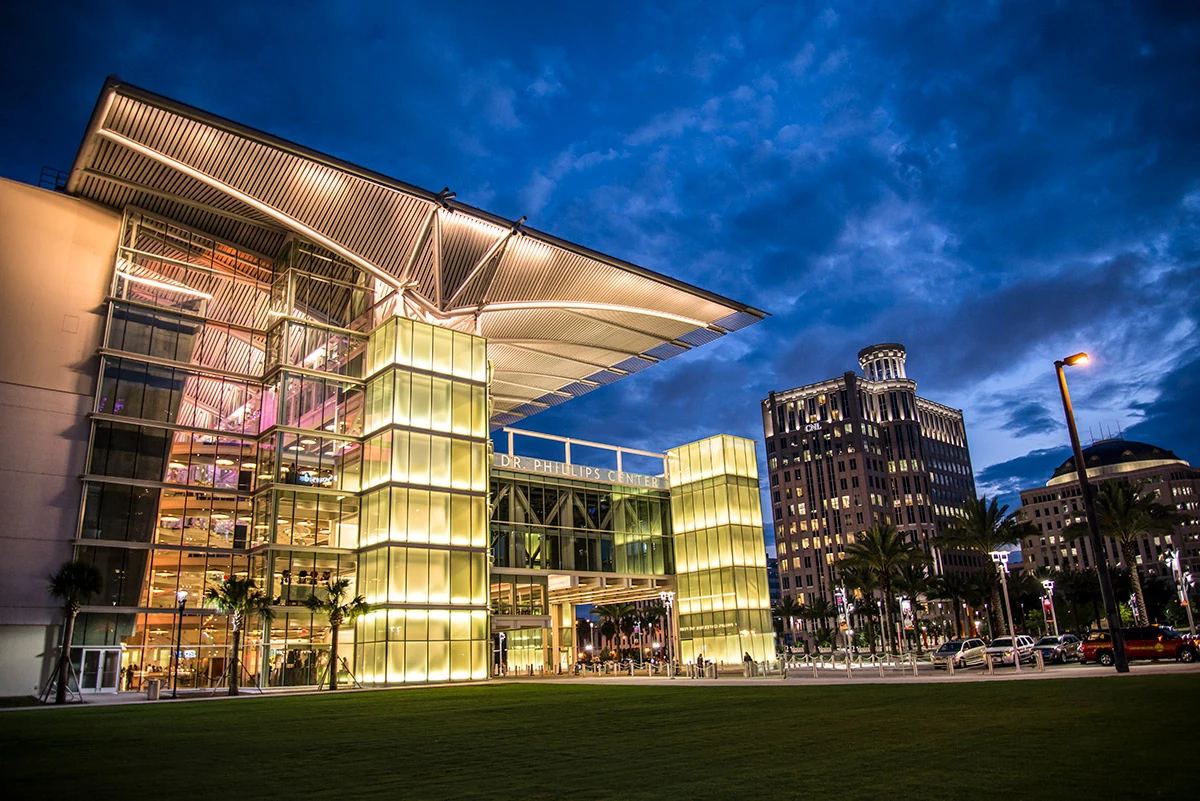
Key Planning Factors for Dr. Phillips Center Events
Documented banquet capacity of 2,700 and reception capacity of 300
Downtown location at 445 South Magnolia Avenue distinct from I-Drive clusters
Integration of 300-plus annual performances spanning Broadway to opera
Recognition by Travel + Leisure and Southern Living since 2014 opening
Right-to-work labor environment with event-specific service manuals
Alignment with official Orlando meetings and conventions resources
Emphasis on cultural programming over pure display-hall scale
Venue Background and Cultural Significance
Opened in 2014, the Dr. Phillips Center for the Performing Arts quickly established itself as a major destination within downtown Orlando. Its rapid rise to prominence is evidenced by inclusions in Travel + Leisure magazine’s list of 25 new attractions worth a visit and Southern Living’s selection of the 50 best places in the South. These acknowledgments reflect more than tourism appeal; they signal a venue capable of delivering memorable experiential layers for corporate and association events that seek to move beyond standard meeting formats.
The center’s stated vision of Arts for Every Life® translates into year-round programming that encompasses Broadway shows, popular music concerts, stand-up comedy, American dance, opera and symphony performances, and family-friendly productions. For event planners, this calendar creates both opportunities and constraints. Strategic coordination involves reviewing the performance schedule early to identify windows where reception or banquet spaces can incorporate live segments without conflict, thereby elevating the overall event narrative with authentic cultural content unavailable in standard convention facilities.
As an authoritative planning resource, the focus remains on matching event objectives to the venue’s documented strengths. The downtown setting at 445 South Magnolia Avenue places it outside the primary I-Drive convention corridor led by the Orange County Convention Center yet still within the wider Orlando meetings ecosystem. This differentiation benefits organizations targeting attendees who value proximity to urban amenities and artistic experiences over resort-style campuses.
Opened in 2014 with immediate national recognition
More than 300 shows annually across multiple genres
Vision statement centers on universal access to the arts
Listed among premier Southern destinations by major publications
Documented Capacities and Space Utilization
Available metrics for the Dr. Phillips Center list a banquet capacity of 2,700 and a reception capacity of 300. These figures position the venue for substantial seated dinners, awards presentations, or galas where the integration of performance elements can create memorable focal points. Without extensive display space listed in official destination data, planning emphasizes configuration of existing areas for display, sponsorship, or interactive zones that complement rather than dominate the artistic programming.
Planners must verify exact room dimensions, ceiling heights, and technical capabilities directly against each event’s service manual, as public data remains limited compared to the Orange County Convention Center’s detailed 2,053,820 square feet of display space and 74 meeting rooms. The performing arts orientation means many spaces are optimized for stage visibility, acoustics, and lighting grids rather than forklift-accessible loading or booth setups typical of pure convention environments.
Successful utilization therefore requires early dialogue on hybrid setups that might combine reception flow with sponsor displays or product showcases timed around intermissions or pre-show periods. This approach respects the venue’s core identity while delivering measurable engagement outcomes for corporate or association audiences.
Banquet capacity reaches 2,700 guests
Reception capacity listed at 300 attendees
Technical infrastructure geared toward performance needs
Verification against current event manuals remains essential
Downtown Orlando Location and Access Dynamics
Situated at 445 South Magnolia Avenue in the downtown district, the Dr. Phillips Center offers a counterpoint to the dense concentration of hotels and facilities along International Drive and the Orange County Convention Center campus. This downtown placement provides distinct logistical considerations, including proximity to the city’s central business and cultural core rather than the tourist corridor that includes SeaWorld, Universal, and Disney-area properties.
Event coordination benefits from the venue’s urban context, where attendees can combine daytime meetings with evening performances or vice versa without extensive shuttling. However, transportation planning must account for the separation from the primary convention cluster that includes properties such as the Hyatt Regency Orlando, Rosen Centre Hotel, and Rosen Shingle Creek. Official Orlando meetings resources highlight the entire region’s connectivity, allowing planners to route groups effectively between downtown cultural events and larger I-Drive activations.
Parking, ride-share access, and pedestrian flow around Magnolia Avenue become important details in the operational plan. The venue’s established presence since 2014 has contributed to downtown revitalization, creating a more sophisticated atmosphere for high-end receptions or recognition events that seek to convey prestige through cultural association.
Labor Environment and Contractor Coordination
Florida functions as a right-to-work state, establishing an open-market labor environment rather than default venue-wide union exclusivity. At the Dr. Phillips Center and similar special-event properties, specific labor rules are outlined in each event’s service manual and exhibitor kit rather than through publicly fixed mandates. This requires planners to confirm responsibilities for setup, technical services, and teardown well in advance.
While the Orange County Convention Center publishes formal exhibitor and exhibitor-appointed contractor conditions with direct ordering for utilities and aerial rigging, special-event venues like Dr. Phillips follow comparable yet distinct protocols. Coordination therefore centers on clear delineation of what the venue handles internally versus what outside contractors may provide, always referencing the latest documentation to maintain compliance and operational smoothness.
The absence of verified venue-wide union requirements allows flexibility, yet final determinations rest with the show organizer, designated service contractor, and house policies. Early engagement with these documents prevents last-minute adjustments during move-in or performance integration periods.
Right-to-work state supports open labor market
Event-specific manuals dictate exact responsibilities
No public venue-wide union mandate identified
Cross-reference with official Orlando planning resources
Integrating Performing Arts into Event Strategy
The center’s calendar of Broadway, opera, symphony, comedy, dance, and family productions creates natural avenues for thematic enhancement of corporate events. Planners can explore programming alignments where a pre-event reception flows into a curated performance segment or where sponsor activations occur in lobby areas during intermissions. This integration differentiates events held at Dr. Phillips from those confined to ballroom or display spaces at nearby Rosen Plaza or Caribe Royale properties.
Successful execution depends on advance review of the venue’s performance schedule and technical rider requirements. The same infrastructure that supports international artists can be leveraged for custom staging, lighting, or audio elements that reinforce brand messaging or conference themes. Such coordination transforms a standard gala into an experience that attendees associate with Orlando’s cultural depth rather than solely its theme-park reputation.
Operational detail includes timing attendee movement between reception zones and performance halls, ensuring smooth transitions that respect both artistic requirements and event flow. The venue’s reputation as a hub for local and international talent further supports narratives of authenticity and excellence in post-event communications.
Logistics Within Orlando’s Meetings Ecosystem
Orlando’s meetings infrastructure, as framed by official destination marketing, encompasses the 7,000,000 square feet of meeting and event space at the Orange County Convention Center alongside specialized venues such as the Dr. Phillips Center. This ecosystem supports routing events between downtown cultural experiences and larger convention activities on the I-Drive corridor or in the Disney/Bonnet Creek and Lake Nona clusters. Coordination at the performing arts center therefore forms one tactical element within a larger regional strategy.
The Grand Concourse Expansion at the convention center illustrates ongoing investment in the market; similar forward planning at special-event venues focuses on maintaining technical standards that meet expectations of sophisticated exhibitors and attendees. For events at Dr. Phillips, logistics extend to advance registration of technical needs, confirmation of loading access suitable for performance equipment, and contingency planning should overlapping downtown events create congestion.
Reference to Visit Orlando’s centralized resources helps streamline supplier selection and service ordering. The emphasis remains on precision scheduling, clear communication of capacities, and alignment with each property’s documented capabilities rather than assumptions based on neighboring facilities.
Part of official Orlando meetings destination network
Distinct from OCCC’s 2.1 million square feet of display space
Supports multi-venue itineraries across Orange County
Ongoing market expansions influence planning timelines
Best Practices for Execution and Measurement
Detailed pre-event timelines should map every phase from initial site selection through final teardown, paying particular attention to the interplay between banquet setups, reception flows, and performance schedules. Documentation of all technical riders, labor assignments, and capacity confirmations creates a single source of truth that reduces on-site decision pressure. Given the venue’s focus on artistic presentation, rehearsal periods for any integrated segments warrant dedicated blocks in the master schedule.
Post-event evaluation benefits from tracking both quantitative attendance against the 2,700 banquet or 300 reception maxima and qualitative feedback on the cultural components. Comparison against events held at Hilton Orlando, Rosen Shingle Creek, or Signia by Hilton Bonnet Creek can highlight the unique value delivered by downtown performing-arts integration. This data informs future routing decisions across Orlando’s varied venue clusters from Winter Park to ChampionsGate.
Throughout the planning cycle, adherence to verified facts from official listings prevents misalignment. The Dr. Phillips Center’s established track record since 2014 provides a stable foundation for events that prioritize memorable experiences within a right-to-work labor framework and a dynamic downtown setting.
Positioning Relative to Surrounding Orlando Venues
Within the I-Drive/Convention District cluster that includes the Orange County Convention Center, Hyatt Regency Orlando, and multiple Rosen properties, the Dr. Phillips Center occupies a specialized niche. Its downtown address and performing-arts orientation contrast with the larger display-focused and hotel-based inventory found along International Drive or in the Disney/Bonnet Creek area. This differentiation allows planners to construct multi-day programs that combine daytime convention activity with evening cultural events without duplicating venue characteristics.
Secondary clusters in Lake Nona, Sanford, or Winter Garden serve airport-adjacent or suburban needs, whereas Dr. Phillips supports organizations targeting the authentic urban core. The absence of on-site sleeping rooms, as seen at the Hilton or Caribe Royale, necessitates coordination with nearby downtown hotels, further illustrating the importance of ecosystem-level planning rather than single-venue isolation.
By focusing on documented capacities, performance programming, and location-specific logistics, event coordinators can leverage the Dr. Phillips Center for activations that achieve measurable differentiation. Its continued role in Orlando’s meetings narrative stems from this ability to deliver experiences grounded in arts excellence rather than scale alone.